Knowledge
A fair random draw: so viewers trust the result
Randomness is a matter for machines, while fairness is a matter of trust. A technically correct draw will still be doubted if viewers can verify nothing. This article explains what a "random draw" actually is and the concrete steps that help the result be accepted.
What "random draw" means
A random draw selects winners so that every person still on the list has an equal chance and no one can predict the outcome. This differs from people's feeling of "random": we tend to think results should be evenly spread, so we get suspicious when two people from the same department win in a row. In fact, those results are entirely possible in a truly random process.
A fair draw needs four conditions:
- A complete and accurate list. Eligible people are on it; ineligible people are not.
- An unbiased selection mechanism. No one is favored or quietly excluded.
- Rules announced in advance. Number of prizes, eligibility to claim, how absent winners are handled.
- A trail to check afterwards. Who won which prize, and when.
The mechanical side: how the tool picks people
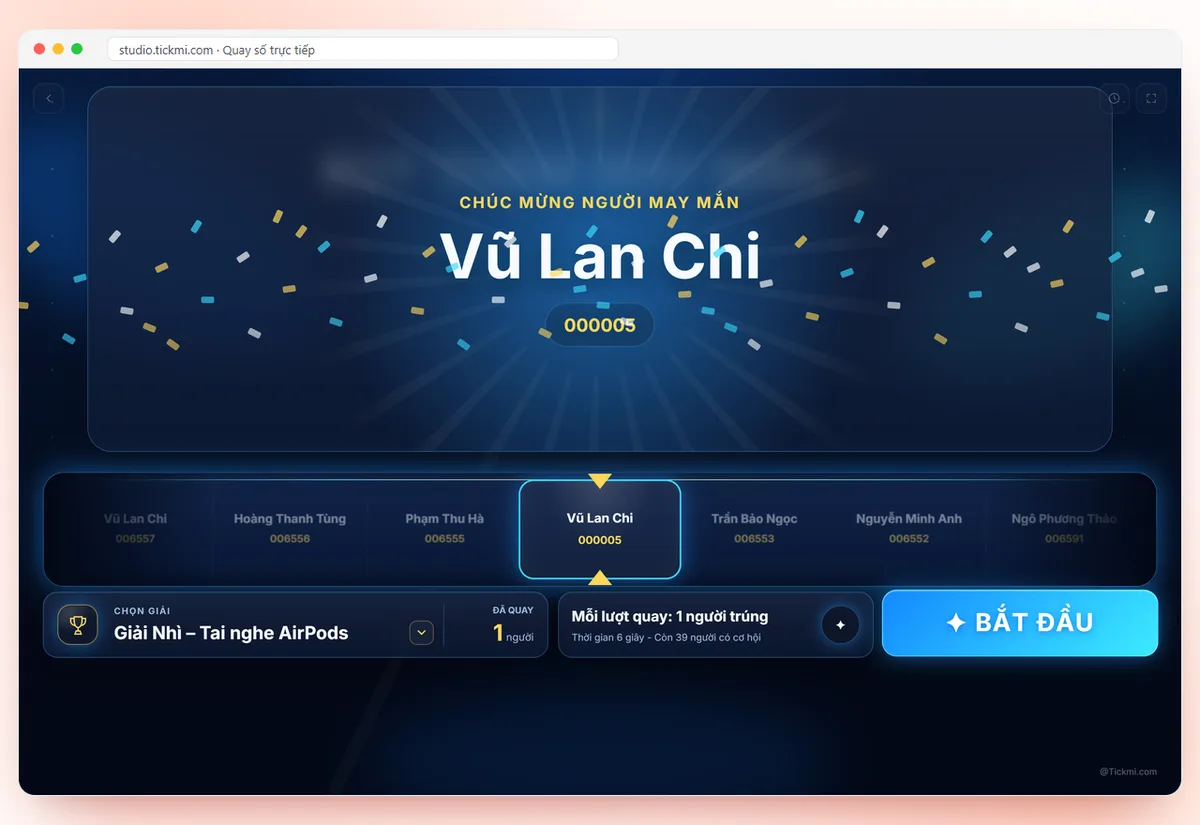
With Tickmi's online lucky wheel, winners are chosen using the browser's secure random number generator (crypto.getRandomValues), not a simple random function. Each person still on the list has an equal chance. When several people are drawn in one round, a person already chosen cannot be chosen again in the same round.
One thing to understand correctly so you don't misstate it to the audience: the names scrolling on screen are a presentation effect, while the winner is chosen when the draw starts and revealed when the time is up. The effect does not change anyone's probability. Tickmi does not publish an independent audit of this mechanism, so don't advertise it as "certified". Say only what is true. If you just need to draw numbers or pick names quickly, you can use the free online lucky draw tool on tickmi.com.
How to make viewers trust it: public, live, with a trail
A good mechanism is not enough. Trust comes from what viewers can see:
| Action | What viewers can verify |
|---|---|
| Show the list (or the count) before drawing | Their name is in the draw, with no strange names |
| Draw live on a large screen | No step happens backstage |
| Have an attendee press the button or act as witness | The operator is not someone from the organizing team |
| Read the rules before the first draw | The rules don't change midway |
| Save the history and download the results file | There is a record to check against when needed |
If the draw list is the list of people who have checked in, you gain another layer of trust: everyone knows the only condition is being present. Details on rules and absent winners are in transparent lucky draws; this article focuses on verification and announcement.
For small groups, a random wheel shown on a screen lets everyone see with their own eyes which name the wheel stops on, instead of just hearing the result read out.
A fair draw process in 6 steps
- Finalize the list and count it. Match the number of people in the tool against the original list. Hypothetical example: if the original list has 120 people, the screen must show all 120.
- Remove ineligible people in advance according to the rules, before opening the draw screen, not midway.
- Read the rules on stage: number of prizes, winners per draw, time to claim gifts.
- Run one trial draw and then delete the trial result, so everyone sees how it works.
- Run the official draw without stopping midway and without redrawing just because you aren't happy with a winner.
- Save the results immediately: download the winners list, take a screenshot and post a public announcement.
Hypothetical example: a 3-prize draw for 120 people
Suppose the organizers have 120 attendees and 9 prizes (1 first prize, 3 second prizes, 5 third prizes). A fair and easily verified approach: show the number of participants (120) before drawing; read the rules once; draw the third prizes first, then the second, and the first prize last; change the prize name on screen for each prize so viewers know what is being drawn; after each prize, winners are removed from later draws so no one receives two gifts.
At the end of the event, the organizers post one public announcement listing the 9 winners and download the history file to keep. If someone asks why one department won several prizes, the answer is that everyone had an equal chance, and the record shows each draw.
Communicating the results after the draw
Many disputes arise after the draw, not during it. Announce briefly and completely:
- The list of winners with prize names, in the same announcement.
- How to claim gifts and the deadline.
- How absent winners are handled, following the rules stated from the start.
- Personal information only at the necessary level: name and organization, no phone numbers or emails posted.
If attendees have questions, bring out the history file to check against instead of explaining verbally.
The mistakes that cause the most suspicion
| Mistake | How to avoid it |
|---|---|
| Redrawing because "the winner isn't suitable" | Say in advance: the first result is the official result |
| The list changes close to draw time without notice | Lock the list and announce the cut-off time |
| The operator is someone with a stake in the outcome | Invite an attendee or guest to press the button |
| Not saving the results | Download the CSV right after each prize |
| Over-promoting a "fair algorithm" | State only what can be verified, such as the random selection method and the history |
| Vague rules about absent winners | State clearly the waiting time and how the prize is redrawn |
If you need to structure prizes before the draw, see how to structure lucky draw prizes. For events with tickets and check-in, the live lucky draw guide shows how to draw from people who are present and view the winning history; the overview is on the Tickmi lucky draw page. This article is not legal advice: if prizes are of high value or used for promotions, look into current regulations or ask a specialist.
About Tickmi
Tickmi is a ticketing and attendee experience platform (Ticketing & Participant Experience Platform). On a single, unified set of attendee data, Tickmi connects the whole journey: issuing invitation, registration and paid tickets, sending branded QR tickets, checking in with the app, kiosk or scanner (even when the network is down), and then welcome screens, lucky draws, voting, quizzes and surveys. Tickmi is trusted by organizations such as Viettel, VNPT, MobiFone, FPT and CMC. Learn about Tickmi or try it free.
Frequently asked questions
Is a random draw really fair?
In terms of mechanism, every person still on the list has an equal chance. Fairness in viewers' eyes also depends on an accurate list, rules announced in advance and results with a verifiable trail.
How does Tickmi's wheel choose the winner?
It uses the browser's secure random number generator (crypto.getRandomValues). The names running on screen are an effect and do not affect anyone's probability.
Should you redraw when the winner is absent or ineligible?
Only redraw according to rules announced from the start, for example wait a few minutes and then draw a backup prize. Redrawing on a whim is the mistake that most easily causes suspicion.
How do I prove the result when someone asks questions?
Open the drawn results panel and download the winners list (CSV) with prize names, winners and times. A concrete record is more convincing than an explanation.
Should the organizers press the draw button themselves?
They can, but inviting an attendee or guest to press it increases credibility, because viewers see that the operator has no stake in the outcome.
Issue QR tickets, send emails, check in and engage attendees on one platform.