
Knowledge
How to run a transparent, fair lucky draw
The lucky draw is the most anticipated part of many events, but a single suspicion of a "fix" is enough to ruin the experience. These are the principles that keep the draw both fun and transparent.
Transparency starts with the rules
Before talking about tools, write clear rules and publish them in advance. The rules should at minimum answer:
- Who can take part in the draw?
- How many prizes are there, how many winners per prize, and in what order are they drawn?
- Can one person win several prizes?
- What happens if a winner is absent?
- The deadline and method for claiming prizes.
Publish the rules by email before the event, on screen before the draw, and have the emcee read them out again. When everyone knows the rules beforehand, the results are easier to accept.
Eligibility: tie it to check-in
The most common and fair approach is that only people who have checked in are in the draw list. The benefits:
- Fewer cases of drawing someone who is not present.
- It encourages attendees to arrive on time and check in properly.
- The draw list is determined by data, not a hand-compiled list.
For events with several audiences, you can limit by group, for example a prize reserved for employees or for customers. State this clearly in the rules.
Draw live on a large screen
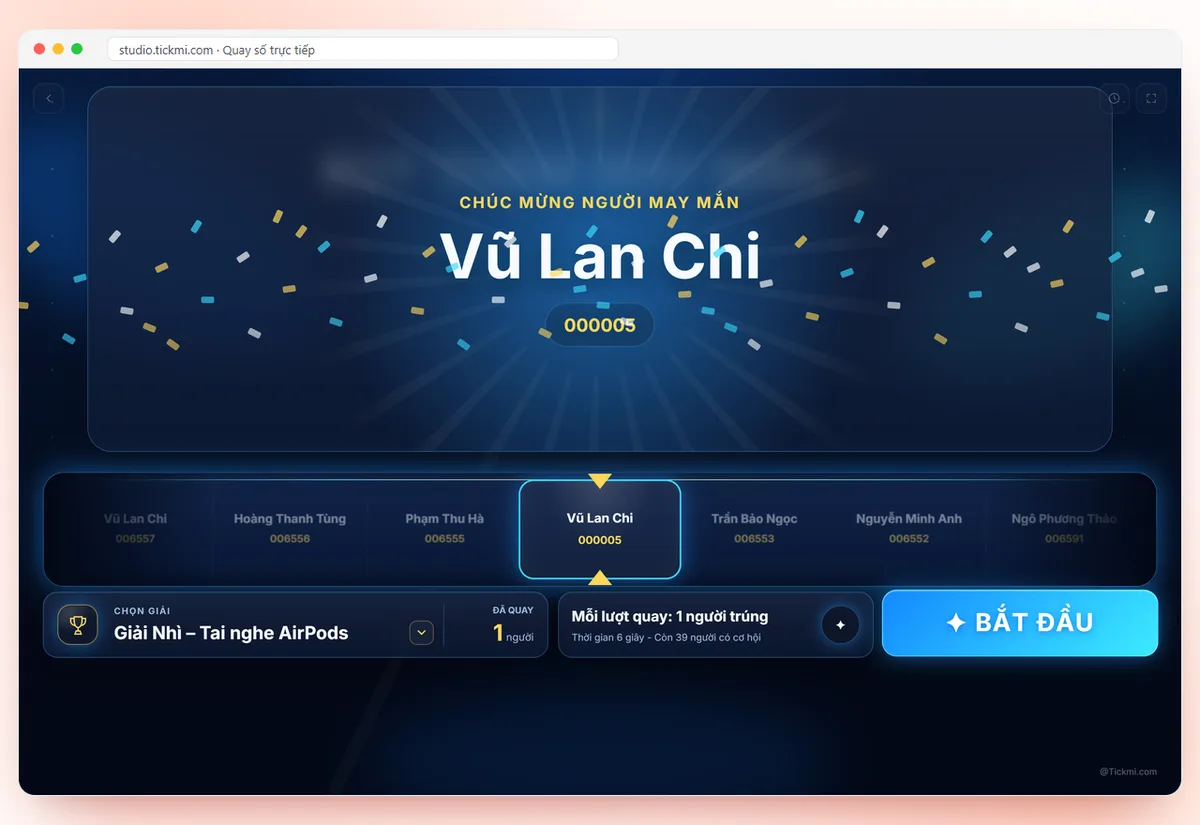
Drawing on a screen the whole hall can see is far more transparent than drawing lots backstage. A few notes:
- Clearly show the name of the prize being drawn and the number of winners.
- Show enough information for the winner to recognize themselves (name, Ticket code or ticket number), but consider not showing personal data such as phone numbers.
- Have the emcee confirm the winner is present before moving on to the next draw.
Keep a draw history
Every draw should be recorded: which prize, who won, and when. This history is used to cross-check when handing out prizes, answer questions after the event and serve as a basis if there is a complaint. Avoid handwritten paper records, which are error-prone and hard to prove.
Handling absent winners
This is the situation most likely to cause disputes if not agreed in advance. A few options:
- Call the name within a set time (for example a countdown on stage); if they are not present, redraw that prize.
- Reserve the prize for the winner to collect later, which suits internal events where the winner may be absent for work.
- Draw backups in advance, a few people for each major prize.
Whichever you choose, write it in the rules and apply it consistently to every prize.
Run a test draw before the official time
A test draw lets you check the screen, sound, effects and attendee data. The important thing is that test draw results must be fully cleared before the real draw, so that the number of prizes and the list of eligible people are fully restored. Do not do the test draw in front of attendees.
What to avoid
- Changing the rules on stage.
- Drawing with a spreadsheet on a personal laptop, not shown to the audience.
- A hand-compiled draw list that may miss or duplicate people.
- Pre-determining a winner without announcing it: if a prize is reserved for one person or group (for example an appreciation award), say clearly that it is a presented award, not a random draw.
Quick checklist
| Before the event | During the event | After the event |
|---|---|---|
| Write and publish the rules | Read the rules again before drawing | Cross-check the draw history when handing out prizes |
| Configure prizes and the number of winners | Draw on the large screen | Contact winners who have not claimed prizes |
| Do a test draw, then clear the test results | Confirm winners are present | Archive the results |
Lucky draw with Tickmi
The lucky draw on Tickmi lets you configure prizes, choose the set of eligible attendees (for example people who have checked in), draw live on the presentation screen, view the draw history and clear all test draws before the real draw.
Frequently asked questions
Should only people who have checked in take part in the draw?
Yes. This reduces cases of winners who are absent, encourages attendees to check in and means the draw list is determined by data.
What if a winner is absent?
Agree beforehand in the rules: redraw that prize after a waiting period, reserve the prize, or use backup winners, and apply it consistently.
Does a test draw affect the real results?
No, as long as you clear all test draw results before the real draw to restore the number of prizes and the list of eligible people.
Issue QR tickets, send emails, check in and engage attendees on one platform.