
Knowledge
Selling event tickets online: on your own page or on a marketplace?
If buyers already know you, selling tickets on your own page usually fits better because you own the buyer data and the brand. If you need to reach strangers, a mass-market ticket marketplace has the advantage in reach. This article compares the two approaches on six criteria and also covers the case where you need nothing more than a simple form.
How do the two ticket-selling models differ?
Selling tickets yourself means you have your own ticket page for the event and you send buyers there; a ticket marketplace is where many events are listed together so strangers can find them. The two models are not mutually exclusive: many organizers have their own page and also list on a marketplace.
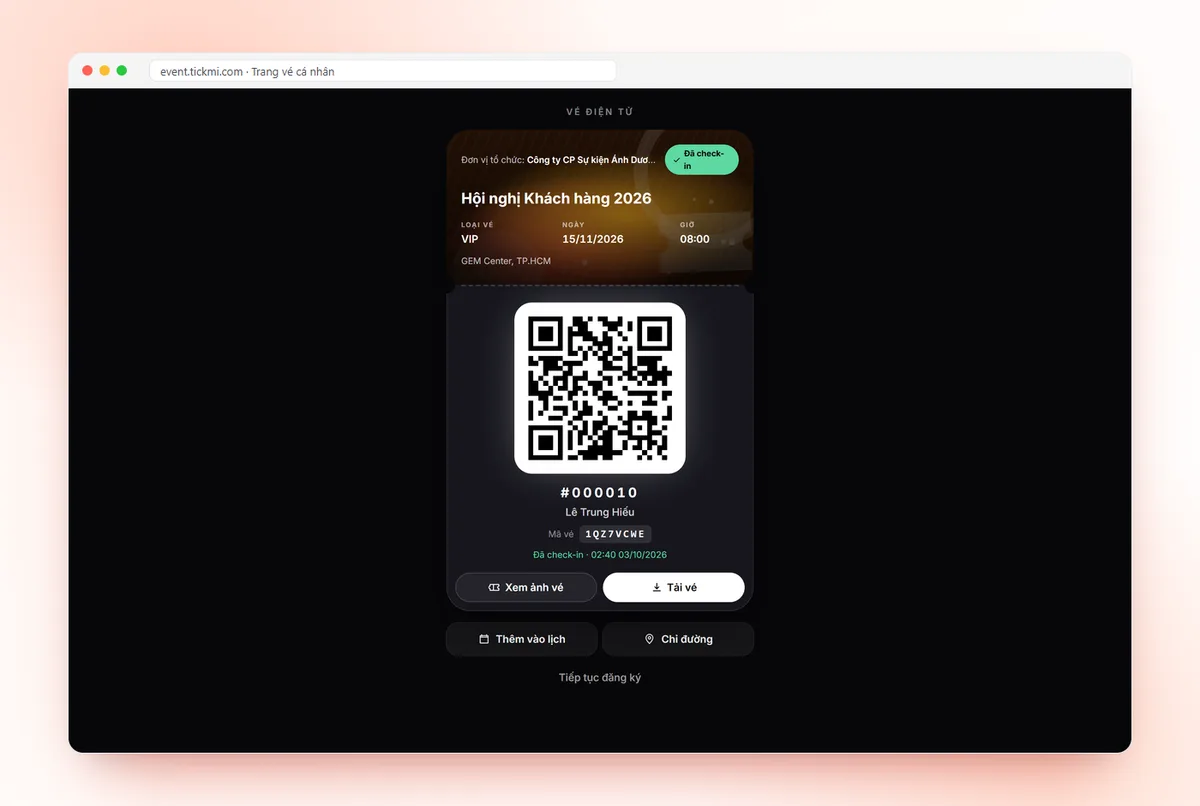
On Tickmi, each ticket product has its own ticket page at ticket.tickmi.com, payment through VNPAY and QR tickets sent automatically. Besides that public link, you can request that your event be shown on Tickmi's shared ticket page; this step requires Tickmi to review the content before it goes live. If you are looking into how to sell event tickets online on Tickmi, that is the starting point.
Six criteria for deciding
| Criterion | Selling on your own page | Listing on a marketplace |
|---|---|---|
| Reach | Depends on your channels: fanpage, email, partners | Extra people who find it by chance, but sales volume is not guaranteed |
| Buyer data | You own the name, email and phone for follow-up and reminders | Depends on the marketplace's policy; some only share part of it |
| Branding | The page carries your identity | The page follows the marketplace's common template |
| Payment and payout | Money arrives on the platform's reconciliation cycle | Each marketplace has its own schedule; ask clearly before signing |
| Buyer support | You or the platform provider respond | The marketplace usually has a general support channel, but you still need to answer about event content |
| Check-in | Tickets and check-in use the same system | Check whether the marketplace exports a list or integrates ticket scanning |
Reach: what a marketplace helps with, and what it doesn't
A marketplace helps when your event attracts people who don't know you yet, for example a performance, an open workshop or a fair. It helps little when buyers are your own customers, students or employees, because they already have the link in hand. Don't expect a marketplace to bring hundreds of people on its own: sales volume still depends on your content, price and communication.
Data and branding: what is easy to overlook
The buyer list is a long-term asset. If the event repeats every year, a complete list helps you send reminders, invite people back and understand the return rate. When you sell yourself, you collect information with questions you set, for example company and job title. When selling through a marketplace, ask in advance: which data you receive, in what format and when.
Payment and payout
For tickets sold through Tickmi, buyers pay through VNPAY; Tickmi transfers ticket sales proceeds (after deducting the platform fee) to the account you declared, on each reconciliation cycle. By default reconciliation happens once after the event ends; you can agree on weekly or monthly during the sales period, and you review and confirm the reconciliation statement in Tickmi Studio. The fee structure has a part based on ticket price and a fixed part, see types of fees when selling tickets online.
When comparing with another marketplace, ask exactly three questions: what the fees include, how long until the money arrives, and which party handles refunds.
The burden of buyer support
Wherever you sell, you are still the one who answers questions about event content, schedule and parking. What changes is the technical part: lost ticket emails, payments charged but no ticket issued, refunds. Check whether the platform lets you look up orders and approve refund requests. In Tickmi Studio there is an Orders section and a list of refund requests submitted by buyers for you to approve; Tickmi carries out the refund.
Check-in: where the two models show their difference
When tickets are sold and checked in on the same system, the person scanning at the gate immediately sees whether a ticket is valid and whether it has been used, and you watch entry numbers in real time. When tickets are sold elsewhere, you have to export a list and then import it into a check-in tool, which easily goes out of sync if a buyer changes their name or refunds a ticket close to the date. The scanning process is covered in QR code check-in.
Quick-choice table
- Choose selling yourself when buyers mainly come from your own channels, you need your own data and brand, or you need seamless ticketing and check-in.
- Add a marketplace when the event is public, needs strangers to discover it, and you accept the marketplace's display and reconciliation rules.
- Combine both when you want your own page as the main source and a marketplace to widen reach.
If you are just starting to choose tools, also read event ticketing platforms to understand the general criteria before choosing.
Questions to ask before choosing a sales channel
Before deciding, quickly answer the five questions below; the answers usually point the way.
- What share of buyers will come from your own channels? If most are existing customers, students or followers, your own page is enough.
- Do you need to know who the buyers are? If you plan to invite them back or follow up, complete data is the priority.
- Will many people arrive at once on sale day? If so, check whether the platform has queueing and ticket holding so tickets are not oversold.
- When do you need the money? Events that need to cover costs upfront should ask about the reconciliation schedule from the start, not wait until close to the date.
- Who handles refunds when the event changes? Read the terms before opening sales, because this is hard to change later.
Combined example: a 500-person annual seminar
This is a hypothetical scenario to make things easier to picture. A business club holds an annual seminar for about 500 people. About 350 are returning members, sent the link to the club's own ticket page by email; the rest are people outside the community, so the organizers request additional display on the shared ticket page so strangers can find it. Every ticket has a unique QR code and sits in one attendee list, so on the day only one scanning system is needed. The organizers keep the data of both groups, reconcile orders in one place and know exactly which group showed up in full.
Takeaway: your own channel is the base, the public channel is the supplement. Whichever channel you choose, start by preparing ticket types, the maximum tickets per order and a clear sales period before announcing.
When you don't need a ticketing platform
If the event is small, sold to people you know, and you can collect money by direct bank transfer, a registration form with a payment tracking sheet is enough. A platform is worth using when order volume is high enough that reconciling bank transfers by hand causes errors, or when many people buy at once. For a hot sale launch, Tickmi has a virtual queue so buyers enter in order instead of scrambling.
Read next: event tickets: types and how to issue them.
About Tickmi
Tickmi is a ticketing and attendee experience platform (Ticketing & Participant Experience Platform). On a single, unified set of attendee data, Tickmi connects the whole journey: issuing invitation, registration and paid tickets, sending branded QR tickets, checking in with the app, kiosk or scanner (even when the network is down), and then welcome screens, lucky draws, voting, quizzes and surveys. Tickmi is trusted by organizations such as Viettel, VNPT, MobiFone, FPT and CMC. Learn about Tickmi or try it free.
Frequently asked questions
Should I sell tickets myself or through a marketplace?
If buyers come from your own channels and you need your own data and brand, sell on your own page. If you need strangers to discover the event, you can also list it on a marketplace. The two approaches can be combined.
Is Tickmi a ticket marketplace?
Tickmi is a ticketing platform: each ticket product has its own ticket page on ticket.tickmi.com. You can also request display on Tickmi's shared ticket page, and the content must be reviewed by Tickmi before it goes live.
When does ticket money reach my account?
Tickmi reconciles by cycle. By default once after the event ends, with weekly or monthly possible by agreement. You confirm the reconciliation statement, then Tickmi transfers the money to the declared account.
Does selling tickets online need a separate integration for check-in?
Not if you sell and check in on the same system. Tickets sold carry a QR code that can be scanned at the gate right away, and entry numbers update in the same system.
Issue QR tickets, send emails, check in and engage attendees on one platform.